
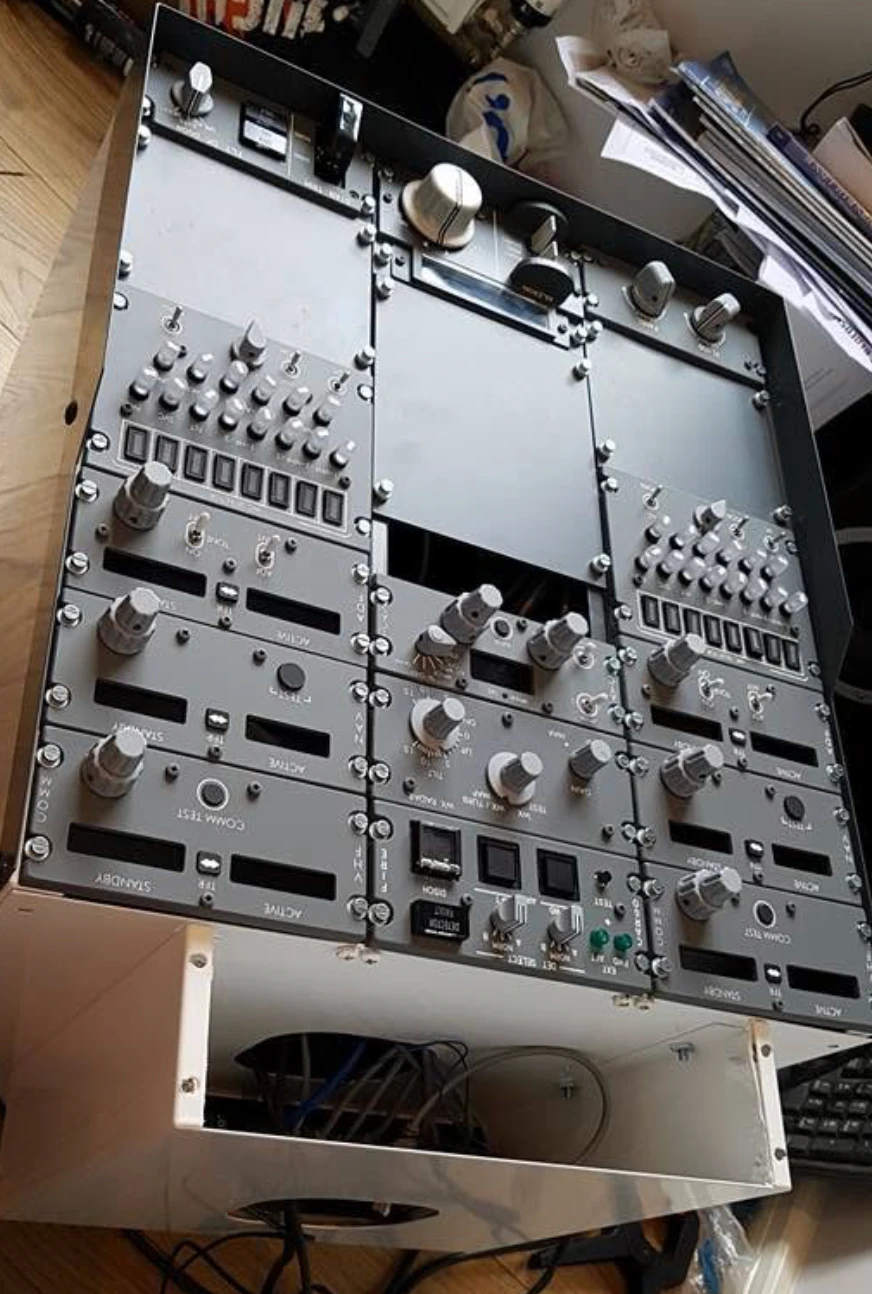
A collection of interfaces in one assembly
A centre pedestal groups several distinct interfaces into a confined area. Controls, displays, lighting, mounting hardware and connections have to fit together without losing the intended layout.
These prototypes show our early development of that assembly. The portfolio includes unpowered front views, open enclosures and illuminated close-ups, so the project can be understood as hardware development rather than only a finished-looking surface.
Radio communication and navigation
The photographs show rotary controls, transfer buttons and numerical displays associated with simulated radio and navigation interfaces. Some displays are captured in a test state rather than showing an operational value.
The purpose of this work is interaction within a simulator. The panels are not presented as transmitters, airborne avionics or equipment approved for installation in an aircraft. Visible labels are part of the interface being represented.
Simulated fire-system controls
Illuminated red handles, indicator lights and associated selectors appear within the early pedestal assembly. They reproduce the physical interface of simulated fire-system functions.
The term fire suppression in this project refers to a represented aircraft system, not an installed fire-extinguishing system for the premises. These images should not be interpreted as an operational emergency procedure or a statement about the safety equipment required around a simulator.
Working through enclosure and connection space
The open-enclosure photographs show wiring, ribbon connections, supporting boards and internal space before the panels are fully closed. They are useful records of how the assembly was approached and how the visible interfaces connect to the underlying hardware.
This pedestal development is separate from the interface-only forward-overhead concept. The two projects should not be merged into a claim that every assembly uses the same remote-electronics arrangement.
Keeping the development stage visible
We identify these panels as early prototypes because that is what they are. The photographs document test indications, unfinished assembly details and different stages of construction. They are not substituted for a current product specification or a promise of a stocked panel range.
For enquiries, describe the interfaces you need, the space available and the intended software environment. The useful next step may be a panel-layout study, a physical prototype or a broader discussion about how the assembly will be integrated and maintained.